
As the world grapples with the challenges of meeting rising electricity demand, particularly in developing countries, solar energy has emerged as a beacon of hope. In sub-Saharan Africa, where energy poverty is a persistent challenge, the potential for solar energy is vast. Monocrystalline photovoltaic (PV) panels have become a popular choice for solar energy generation in the region. These panels convert sunlight into electrical energy, providing a clean and renewable source of power. However, efficiency is affected by the harsh environmental conditions in arid regions.
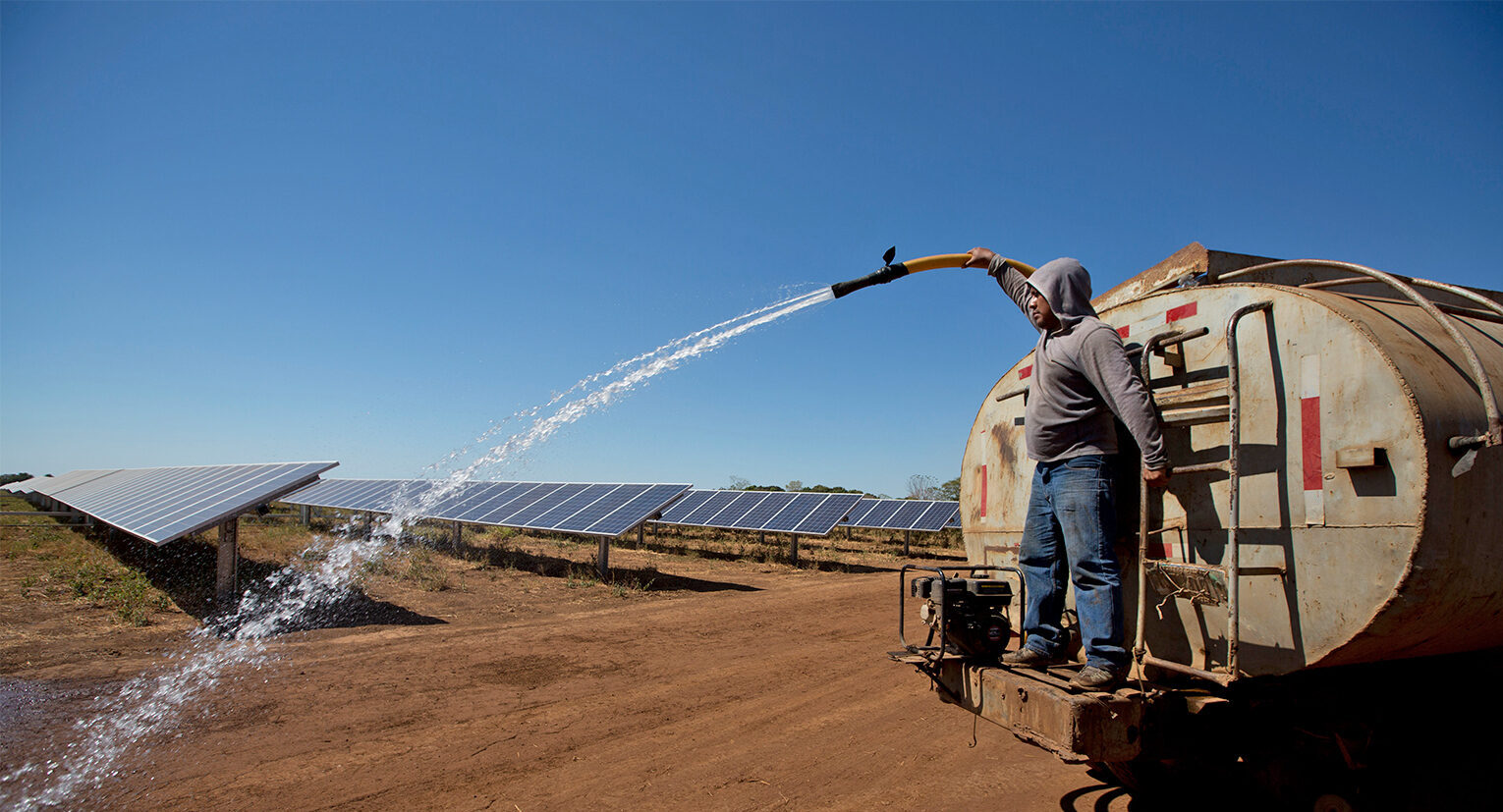
One of the major challenges facing solar panels is the accumulation of dust, bird droppings and other contaminants on the panel surface. Research has shown that dust accumulation can significantly reduce a solar panel’s power output up to 56% over time, compared with clean modules. Research also shows that the method of cleaning affects solar panel efficiency, depending on whether soap or pressurized water are used. “Cleaning using water is an effective method but it needs pressurized water or a cleaning brush to help the water to remove sticky or muddy particles,” the authors of a 2013 Energy Conservation and Management study write. The study also notes that surfactants (soap) help maintain the panel’s efficiency.
In many parts of the world, manual cleaning of solar panels using water, brushes and mild soap is a common practice, but it has downsides: It can be labor-intensive, and in arid regions, where water scarcity is a significant issue, manual cleaning of solar panels is not a viable option. To address this challenge, a team of innovators has designed an automated waterless solar panel cleaning system. According to the researchers, “The system uses an ejector blower for air jet cleaning and a flexible brush for dust sweeping, ensuring efficient cleaning.” This innovative solution is designed to be efficient, cost-effective and environmentally friendly.